
Walk into a martial arts academy on any given evening, and you’ll see something rare: a six-year-old practicing a front kick a few feet from a forty-five-year-old professional working through the same combination, while a teenager helps a grandparent line up a punch. Few activities are genuinely built to serve every one of these people equally well, but martial arts is one of them. It isn’t a sport designed around a particular age group; it’s a discipline designed around growth, and growth happens at every stage of life.
For nearly six decades, Amerikick Martial Arts has built its programs around exactly that philosophy: training that welcomes everyone, regardless of age, gender, or experience level. What was once seen mainly as a self-defense skill is now recognized as one of the most complete lifelong fitness practices. When looking closely at the martial arts benefits for all ages, it becomes clear how these advantages show up differently, but just as powerfully, depending on where you are in life.
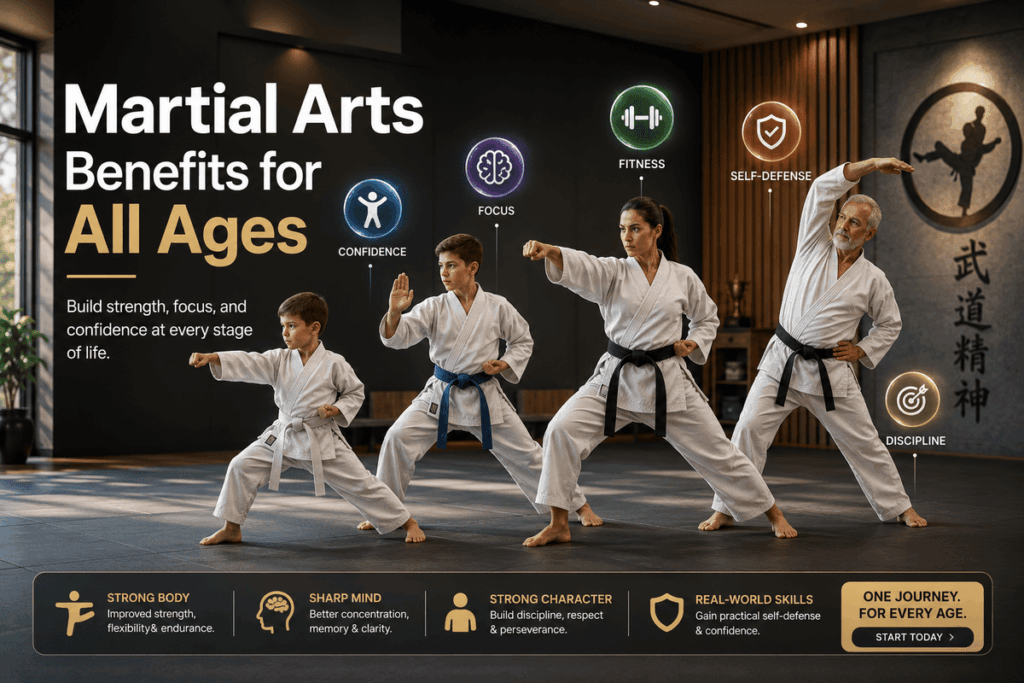
Before breaking things down by age group, it’s worth looking at what stays constant. Whether a student is six or sixty, and whether their training leans toward traditional karate or modern kickboxing, consistent practice tends to build the same core foundation:
What changes from one age group to the next isn’t the value of these benefits; it’s how they show up, and why they matter most. And unlike many fitness trends, these gains tend to compound: a student who starts at seven and is still training at seventeen doesn’t just repeat the same lessons, they build on them year after year.
For many children, martial arts is their first structured experience with discipline outside the home. A well-designed children’s program teaches life skills (a positive attitude, goal-setting, perseverance, and self-control) that carry over directly into the classroom. Parents often notice better listening, longer attention spans, and improved behavior at school within the first few months of training. Following multi-step instructions in class also strengthens coordination and gross motor skills at an age when both are still developing quickly.
The belt-ranking system plays a quiet but powerful role here too. It teaches kids something many adults still struggle with: that big goals are reached through small, visible steps. Every stripe and every new belt is proof that consistent effort produces real results, which is a lesson far more memorable than simply being told to work hard.
Anti-bullying education deserves special mention. The goal isn’t to make children more aggressive; it’s the opposite. Quality Anti-Bully classes teach situational awareness, clear boundary-setting, and a calm, grounded confidence that makes a child far less likely to be targeted in the first place, while giving them real tools if a situation ever does call for it.
Adolescence comes with a unique set of pressures: shifting identities, social comparison, academic stress, and, for most teens, a first real brush with peer pressure. Martial arts gives teenagers something solid to stand on that has nothing to do with trends or popularity.
Training channels teenage energy in a productive direction, builds physical strength during crucial growth years, and creates a peer group organized around mutual respect rather than social status. It also teaches time management. Balancing schoolwork, training schedules, and belt requirements is often a teen’s first real exercise in juggling competing priorities, and having a reliable outlet during stressful stretches like exam season makes a noticeable difference. Many teens also step into leadership roles, helping instructors teach younger students, an experience that builds a level of responsibility and self-assurance that’s genuinely difficult to find anywhere else at that age.
For adults, martial arts solves a problem that has quietly derailed gym memberships for decades: motivation. Running on a treadmill or repeating the same lifting circuit rarely holds anyone’s interest for long. Martial arts training gives every session a purpose, whether it is a technique to refine, a combination to master, or a test to prepare for.
Programs like AKX Kickboxing combine intense cardio conditioning with practical self-defense skills, burning serious calories while building real-world capability. Just as importantly, adult students consistently describe carrying the mental sharpness and composure they build on the mat into the rest of their lives: better focus under pressure at work, more discipline around personal goals, and a far healthier outlet for stress than most jobs naturally provide. There’s also a social element that a solo gym routine simply doesn’t offer: training partners and instructors create accountability, camaraderie, and a genuine sense of community that keeps people coming back long after New Year’s resolutions usually fade.
Martial arts is often overlooked as an option for older adults, but its low-impact, self-paced nature makes it a genuinely strong one. Because training can be scaled to any fitness level, it can support:
Because adult programs are built to welcome every fitness and skill level, starting later in life is far more realistic than most people assume. Many older students find they’re capable of far more than they expected, often surprising themselves within the first few weeks.
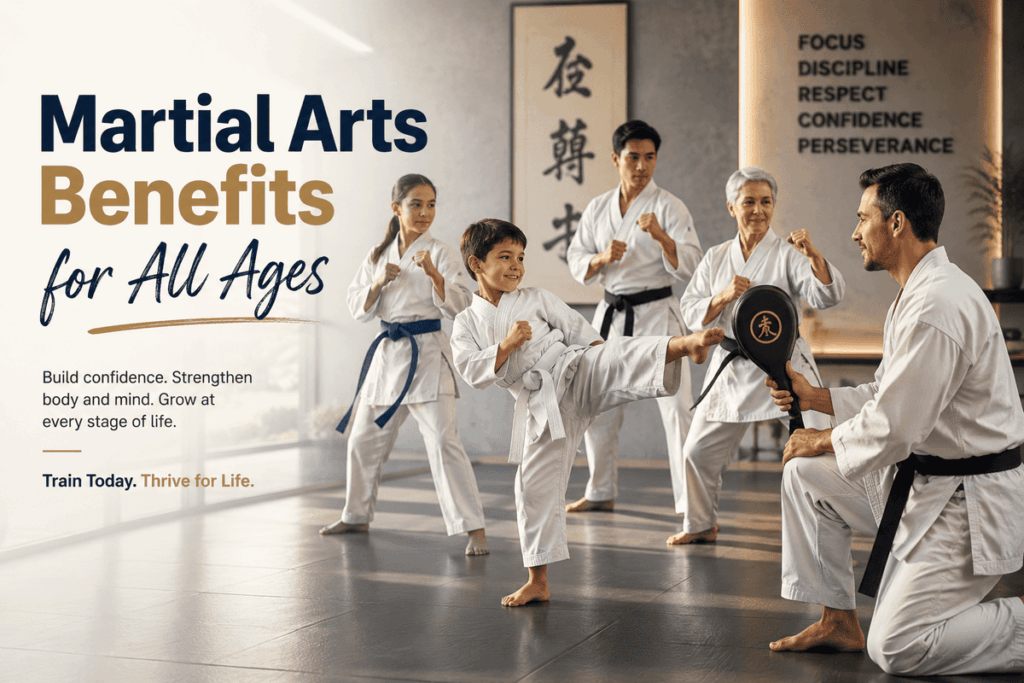
Perhaps the most underrated benefit of martial arts has nothing to do with age at all: it’s one of the very few activities an entire family can genuinely do together. Parents and kids training side by side share something rare: the same goals, the same challenges, and the same small victories, week after week. Cheering each other on at a belt test or practicing a combination together at home builds a shared language that strengthens family bonds far beyond the dojo.
It’s a cycle that tends to repeat itself over time, too. Students who start as young children often grow up, earn their black belts, and eventually come back to teach the next generation, passing along the same values of respect, discipline, and confidence they were taught themselves. At Amerikick, that pattern has played out again and again since the academy’s founding in 1967.
Whatever stage of life you’re in, the door to martial arts is open. It’s never too early to build a child’s confidence, never too late to reclaim your fitness, and there’s no wrong age to start experiencing the incredible martial arts benefits for all ages.
Amerikick Martial Arts offers dedicated programs for children, teens, and adults, with introductory offers at locations designed to make that first step simple. In most cases, the hardest part of training, at any age, isn’t the workout itself. It’s just walking in for the first class.